


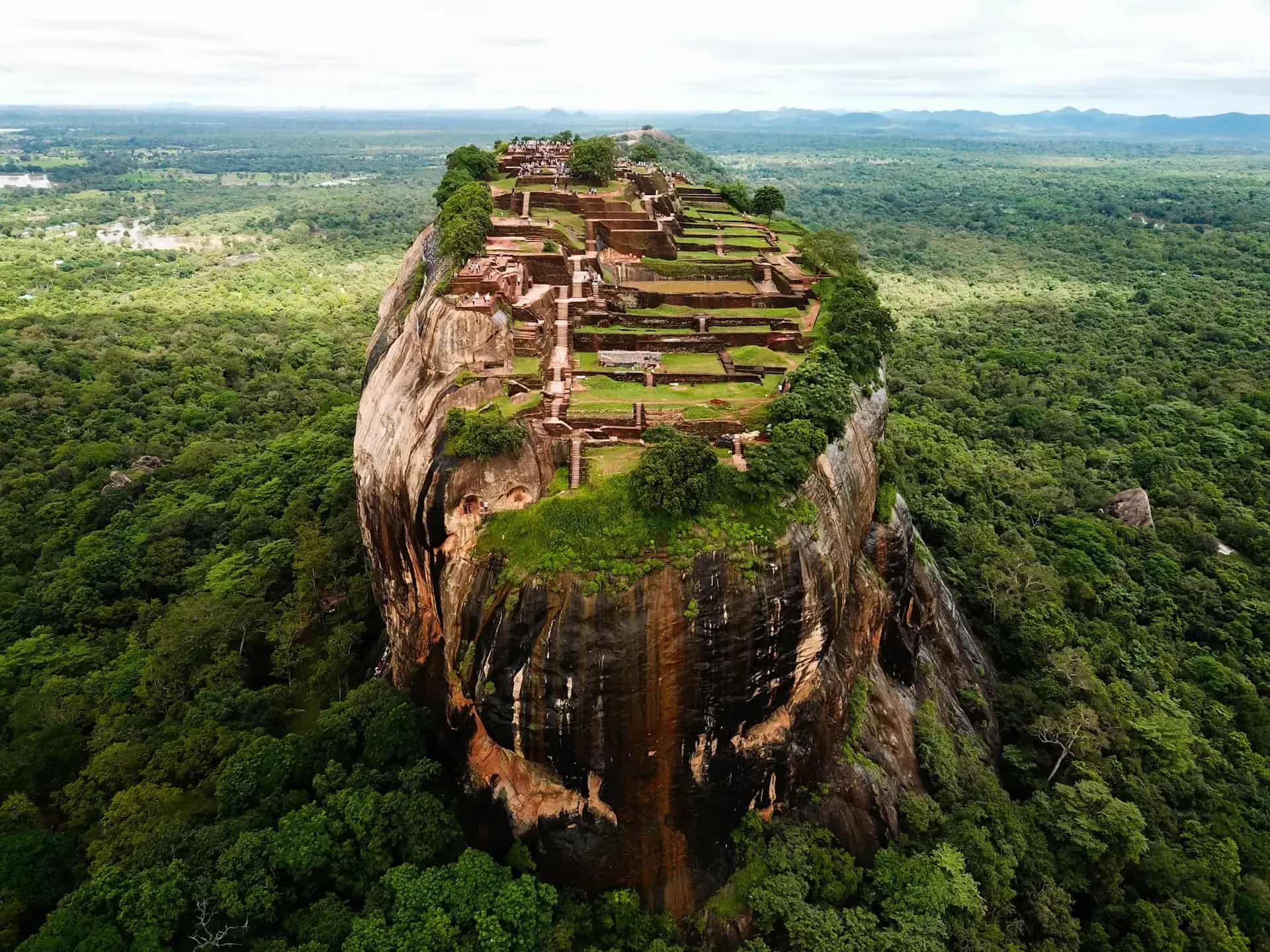
A king’s palace in the sky
King Kashyapa built his palace on top of the rock in the 5th century, with water gardens at its foot and a gateway shaped like a giant lion. Only the paws remain today.
Halfway up, the famous frescoes of the “cloud maidens” have survived for over 1,500 years in a sheltered gallery.
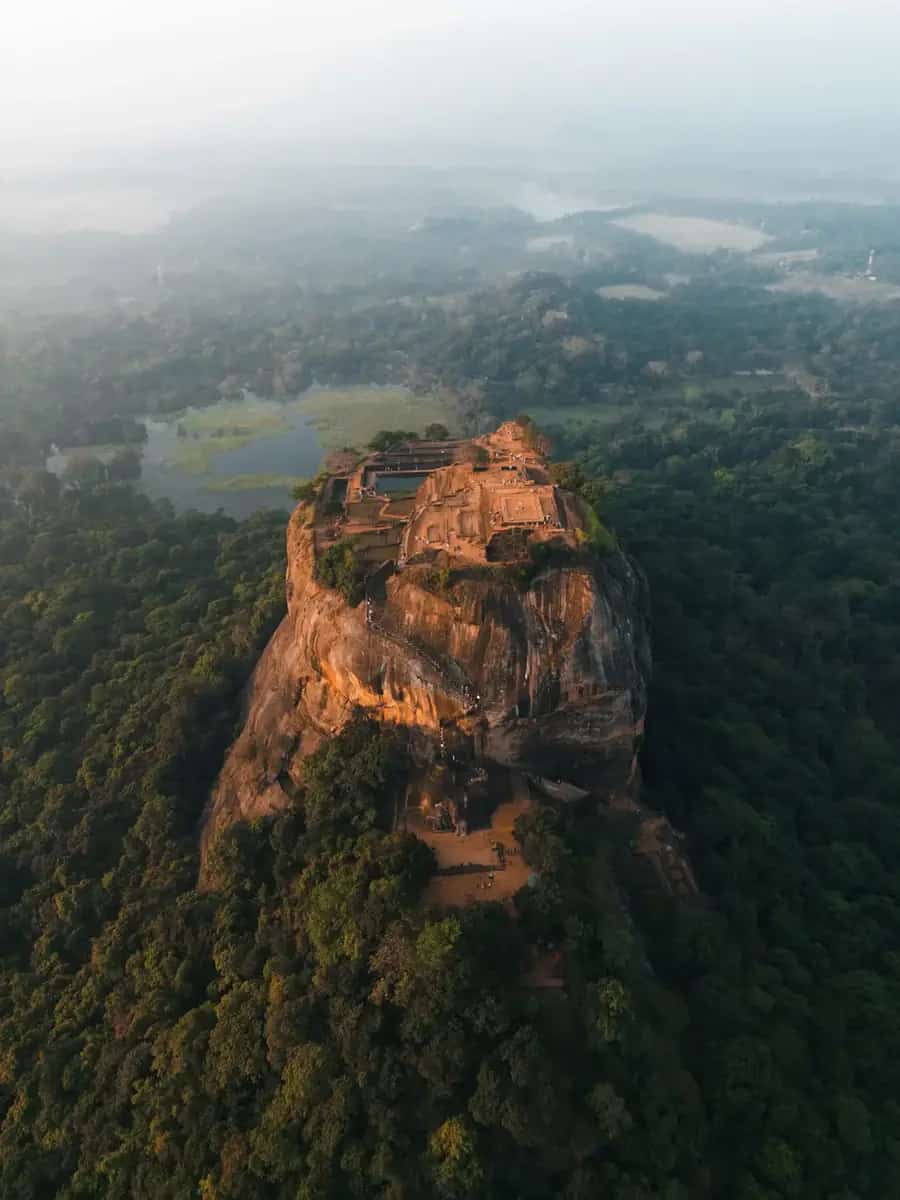
Climbing the rock & when to go
Around 1,200 steps, some on metal stairways fixed to the rock face. It is steady rather than difficult – take it slowly and bring water.
Go at opening time. By mid-morning the rock is hot and the stairways are busy.
The alternative view
The neighbouring rock of Pidurangala is a shorter, rougher scramble past a temple – with the best view of Sigiriya itself, especially at sunrise.
Dambulla & Polonnaruwa
Sigiriya is the centre of the Cultural Triangle. Within an hour lie the Dambulla cave temple, the ruined royal city of Polonnaruwa and Minneriya National Park with its elephant herds.
Visiting Sigiriya: practical tips
Tickets are bought at the counter by the car park near the western entrance; foreign visitors pay a higher rate than locals, and card payment is usually possible. Bring cash as a back-up, a hat, water and shoes with good grip – the metal stairways near the top can be slippery after rain. There are toilets and a small museum at the entrance but little shade on the rock itself.
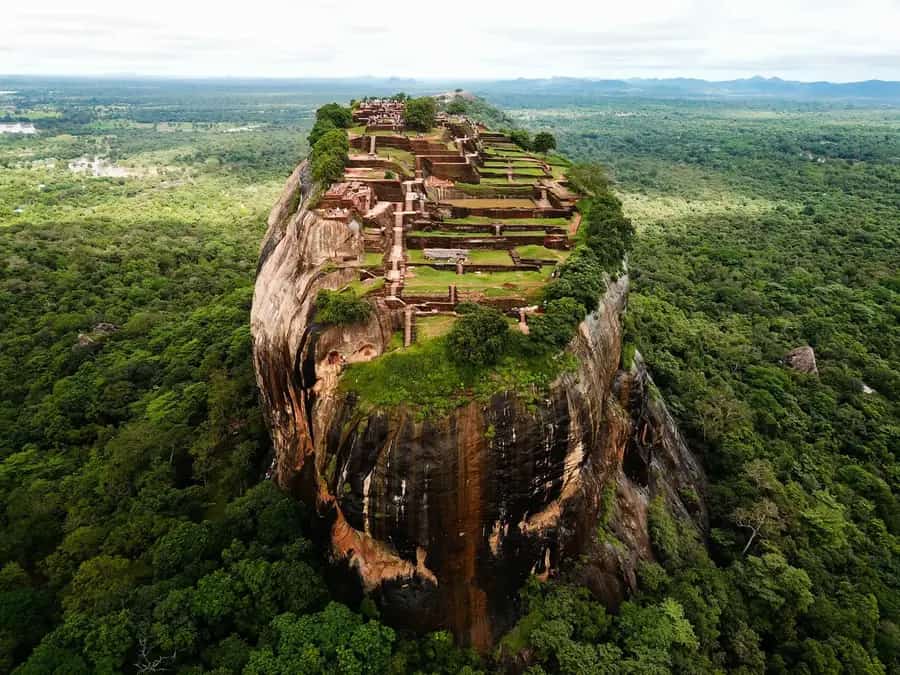
The climb has three parts. First you walk through the symmetrical water gardens and boulder gardens at the foot of the rock. Then a spiral staircase leads to the fresco gallery and the polished Mirror Wall, covered in ancient graffiti. Finally, from the Lion Terrace with its two giant paws, steep stairs take you to the summit, where the foundations of the palace, a large cistern and a 360-degree view over the jungle await.
Sigiriya with children, or with limited fitness
Children who enjoy climbing usually love Sigiriya. The steps are steep in places but protected by railings. If you are uneasy with heights, you can still enjoy the gardens, the frescoes and the Lion Terrace, and wait there while others go to the top. Our guides always climb at the pace of the slowest member of the group.
How long to stay near Sigiriya
We recommend at least two nights in the Sigiriya area. That gives you one morning for the rock, one for Dambulla or Polonnaruwa, and an afternoon safari in Minneriya or Kaudulla to see elephants. Hotels here are set in the countryside among paddy fields and lakes – ideal for a first stop after the flight.
The frescoes and the Mirror Wall
Around a third of the way up, a spiral staircase leads to a sheltered gallery where around twenty painted women – the famous “cloud maidens” – survive from the 5th century. Their identity is still debated: celestial nymphs, ladies of the court, or queens. Photography with flash is not allowed.
Just beyond is the Mirror Wall, once polished so smooth the king could see his reflection. Visitors from the 8th century onwards scratched poems on it praising the paintings – some of the oldest writing in the Sinhala language.
Dambulla cave temple
Twenty minutes south of Sigiriya, the Dambulla cave temple has been a place of pilgrimage for more than two thousand years. Five caves beneath an overhanging rock are filled with over 150 Buddha statues and ceilings covered in murals. It is a UNESCO World Heritage Site and, in our view, just as impressive as the Lion Rock. Allow about an hour, and bring socks – the rock is hot underfoot.
Polonnaruwa and Minneriya
The medieval capital of Polonnaruwa, about an hour east, is spread over a large, flat area – perfect for exploring by bicycle. Highlights include the Gal Vihara, four Buddha figures carved from a single granite rock, and the circular Vatadage. In the afternoon, a jeep safari in Minneriya or Kaudulla National Park often brings sightings of dozens, sometimes hundreds, of elephants.
Sigiriya tickets and opening hours
Tickets for foreign visitors are sold at the ticket office near the main entrance and include the museum. The site opens early in the morning – arrive at opening time to climb before the heat and the crowds. On our small group tours the entrance fee is included; on private tours it is listed in your proposal.
The site opens early in the morning, and we always aim to be at the gate at opening time. Arriving early means cooler air, softer light for photographs and far fewer people on the narrow stairways near the frescoes.
The legend of King Kashyapa
According to the ancient chronicles, Kashyapa seized the throne in the 5th century after the death of his father, King Dhatusena. Fearing revenge from his half-brother Moggallana, he moved his capital from Anuradhapura to the top of this granite rock and built a fortified palace with gardens, pools and a monumental lion gateway.
His reign lasted about eighteen years. When Moggallana returned with an army, Kashyapa rode out to meet him and died in battle. The rock later became a Buddhist monastery, and was forgotten for centuries before British archaeologists rediscovered it in the 19th century. Today it is a UNESCO World Heritage Site.
The gardens of Sigiriya
The gardens at the foot of the rock are among the oldest landscaped gardens in Asia. The water gardens are laid out symmetrically, with pools, channels and fountains that still work in the rainy season, fed by an ingenious system of underground conduits. Beyond them lie the boulder gardens, where giant rocks are linked by paths and stairways, and the terraced gardens that lead up to the rock itself.
Best time to visit Sigiriya
Sigiriya lies in the dry zone and can be visited all year. January to April and June to September are the most reliable months. October to December bring more rain, usually in the afternoon – another reason to climb early. Avoid weekends and public holidays if you can, when many local families visit.
Our hotel picks around the rock
Most hotels are spread among lakes and forest within 15 minutes of the rock. We use Aliya Resort & Spa as our standard base, with views of the Lion Rock from the pool. For a boutique stay, Jetwing Vil Uyana has villas among rice paddies and wetlands; for a special occasion, Water Garden Sigiriya offers private pool villas. Two nights is the minimum we recommend.
Where to stay in Sigiriya
Sigiriya: questions
Allow 2.5 to 3 hours for the climb, the frescoes and the way down.
It is around 1,200 steps. With an average level of fitness and an early start it is very manageable.
Both if you can: Sigiriya for the history, Pidurangala for the view of Sigiriya.